Polygraphia and the Art of Conversion:
Diego Valadés’s Rhetorica christiana (1579) and its Transatlantic Afterlives, 1519–1691
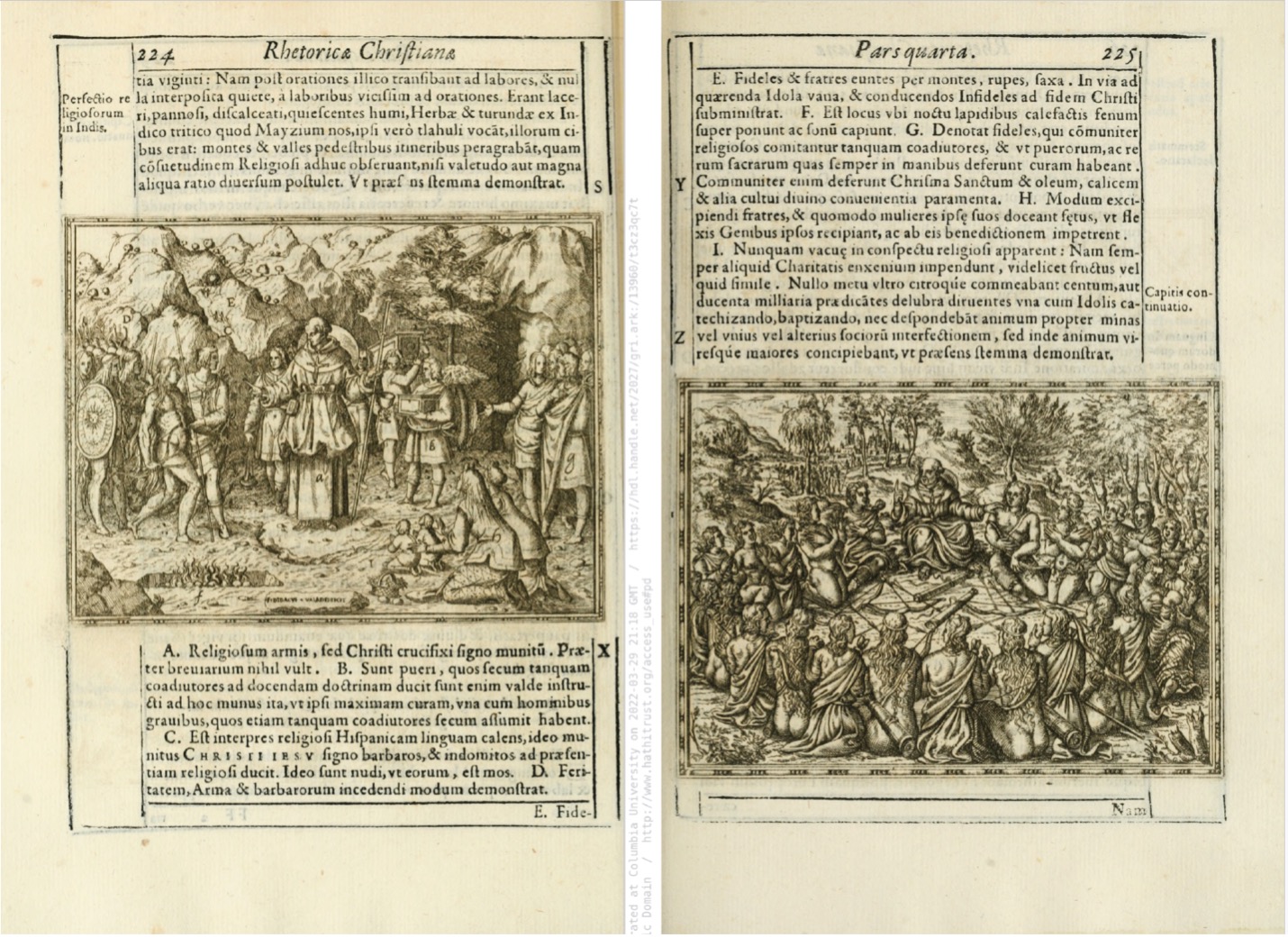
This dissertation examines Diego Valadés’s Rhetorica christiana (Perugia, 1579) as a foundational work in the formation and dissemination of early modern visual and pedagogical methods of evangelization. Although the treatise has most often been studied within the context of sixteenth-century New Spain, this project argues that Valadés articulated a mobile pedagogical paradigm, crystallized in the text and diagrammatic images of the Rhetorica, that circulated beyond the Americas and was subsequently adapted across diverse missionary contexts. Rather than remaining a localized missionary manual, Valadés’s work functioned as a flexible visual-rhetorical model whose strategies shaped religious education and missionary practice in seventeenth-century France and New France. Emerging in Mexico and travelling through Catholic intellectual and institutional networks, including Jesuit colleges, this polygraphic paradigm was reactivated—rather than simply replicated—by Recollect and Jesuit missionaries. By tracing the circulation of texts, images, and pedagogical practices, the dissertation reconstructs a transatlantic history of visual catechesis that links Europe and the colonial world.
The Rhetorica christiana occupies a unique position at the intersection of rhetoric, theology, pedagogy, and image theory. Partly written in Rome during Valadés’s tenure as the General Procurator for the Franciscan Order at the Holy See during the pontificate of Gregory XIII, to whom Valadés dedicates the treatise, and printed in Perugia in 1579 after his expulsion from the Eternal City, the work combines classical rhetorical theory with Christian doctrine and an innovative system of prints designed to aid instruction, memory, and persuasion. In text and image, Valadés thematizes the process of evangelization to articulate a method of teaching that is explicitly visual, spatial, and mnemonic—well-suited to missionary contexts but also adaptable to other educational settings. This dissertation contends that the Rhetorica christiana should be understood not merely as a missionary manual for Indigenous peoples in the Americas, but as a demonstration of a flexible pedagogical toolkit whose visual logic resonated with broader Catholic reform efforts.
Methodologically, the project brings together art history, book history, and histories of education and Christianity. It combines close visual and textual analysis of the Rhetorica with research into its circulation, reception, and reuse across institutional contexts. Given Rome’s nature as a nodal point for missionary activity and religious reform in the sixteenth and seventeenth centuries, I argue that Valadés’s methods infiltrated the networks of intellectual exchange and dissemination that made the diffusion of his proposed polygraphic method beyond New Spain and Rome possible, namely in the proselytizing efforts undertaken in Brittany and in New France (modern-day Québec).
A central aim of the dissertation is to trace how Valadés’s visual pedagogy intersected with the educational practices of both Franciscans and Jesuits. Although Valadés himself was a Franciscan, his work emerged at a moment when Jesuit educational theory and missionary practice were becoming increasingly influential. By examining the evangelical practices outlined in the Rhetorica and those of Jesuit missionaries, the project proposes a series of convergences between Franciscan and Jesuit approaches to visual instruction, even if they were adapted to suit their local context. Rather than seeking direct citation or explicit adoption of Valadés’s work—or, in other words, proving his influence on Jesuit practices—the dissertation focuses on shared strategies—such as diagrammatic thinking, the use of images as cognitive tools, and the spatial organization of doctrine—to posit a paradigmatic transfer of pedagogical strategies rooted in the visual and in the missionary experience in New Spain, thus suggesting a broader culture of visual pedagogy circulating across confessional and institutional boundaries.
The geographical scope of the project connects both interior (Brittany) and exterior (New Spain, New France) Indies, with particular emphasis on the period following the publication of the Rhetorica until the end of the seventeenth century. In France, the dissertation examines the figure of Jesuit-trained priest Michel Le Nobletz and his successor, Julien Maunoir, who developed a series of images—often referred to as tableaux de missions, enigmatic paintings, or taolennoù—to facilitate the teaching of Christian doctrine among the people of Lower Brittany. Trained at the University and the Jesuit Collège de la Madeleine in Bordeaux, where one copy of Valadés’s treatise survives at the Bibliothèque Municipale, and given the striking similarity between his paintings and Valadés’s etchings, Le Nobletz is particularly helpful in postulating the paradigmatic transfer and reception of the Rhetorica christiana. I then turn my attention to New France, where the visual played a foundational role in the colonization and evangelization of the Indigenous Peoples of Eastern Canada. Focusing on the figures of Jean Perron, Claude Chauchetière, and Chrestien Le Clercq, I examine points of contact between their evangelical practices and those of Valadés and Le Nobletz, thus proposing a framework of Catholic global missions made possible by the missionary experience in New Spain.
Ultimately, this dissertation reframes the Rhetorica christiana as a key node in a transnational history of visual pedagogy. It argues that Valadés’s synthesis of rhetoric, image, and instruction helped shape a Catholic visual culture that extended from Mexico through Rome and to France and New France, influencing colonial missionary practice. By foregrounding the mobility of pedagogical methods and the institutional networks that sustained them, the project contributes to broader debates on global Catholicism, the circulation of knowledge, and the role of images in early modern education.